by James Kraus

View of Midtown Manhattan from the Empire State Building across to the Chrysler Building and Queensboro Bridge
There are very few who would immediately associate the canyons of Manhattan and its environs with sporting motoring. New Yorker’s today are largely content with ambling about in conveyances that enthusiasts of the past would rightly describe as tow vehicles, while driving is seen as little more than a distraction to be endured while telephone calls are dispatched and text messages deciphered. Manual transmissions are but a relic and spirited driving eschewed in fear of capsizing Starbucks Caffè Grande’s.
This was not always the case. In the 1950’s and 1960’s, it was quite fashionable among the New World cognoscenti to drive, deliberate over, and otherwise enjoy the world of sporting cars and international motorsport. This was, of course, the halcyon days of Sports Car and Grand Prix racing, when drivers were gentlemen (often of independent means) and competition cars had yet to transform themselves into mobile advertisements. The hub of such activity in the U.S. was New York City.
New York was still the unchallenged capital of U.S. business and commerce, serving as the centre of finance, advertising, fashion, publishing and broadcasting. It also happened to be home to most European automobile importers and customary point of arrival for British and Continental racing drivers travelling on to Lime Rock, Bridgehampton, Watkins Glen and Indianapolis.
As in any social sphere, these automotive professionals and enthusiasts tended to congregate at certain venues. Two locations in particular were well renowned: Le Chanteclaire and the Bella Vista.

Le Chanteclair
Le Chanteclair was owned by René Dreyfus, the French racing driver who piloted his own personal Bugatti to victory in the 1930 Grand Prix of Monaco and defeated the mighty Mercedes Silver Arrows at Pau in 1938 to become French National Champion.
René was in the United States to race at Indianapolis when the German Wehrmacht rolled over the border and occupied his home country. He joined the U.S. armed forces and by the end of hostilities, had turned 40 years old. As there was little likelihood of any motor racing activity in war-torn Europe for the foreseeable future, he decided to turn to the other great passion of most Frenchmen; fine cuisine. Finding the post-war economic climate in Europe no more inviting than for motor racing, he decided he would remain in America and open a restaurant.

Logo from Le Chanteclair ashtray. Courtesy of l’art et l’automobile
His first venture, Le Gourmet, opened on the West Side of Manhattan in 1946. It immediately became a gathering place for the international racing set while gathering favourable reviews for its food and wine. René and his brother Maurice actively ran the show and were nearly always around to greet customers and supervise the proceedings. As the restaurant gained notoriety, business slowly increased to the extent that larger premises were in order.

Les Propriétaires: Maurice and René Dreyfus
In 1953, René and Maurice sold Le Gourmet and opened Le Chanteclair at 18 East 49th Street in midtown, a prime location directly between Rockefeller Center and the Waldorf-Astoria. While the main room was decorated in traditional mid-century Continental Restaurant style, the bar and cocktail lounge were discretely accented with subtle automobile and racing memorabilia, just enough to remind an alert enthusiast as to where he was imbibing.
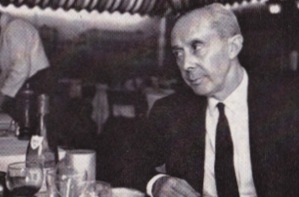
René Dreyfus holds court at Le Chanteclair
Le Chanteclair was a highly regarded restaurant in its own right with a menu steeped in the classical French repertoire and a wine cellar where one could find a bottle of Romanée-Conti ’49 or a Château Latour ’53. Many patrons had little inkling of its motorsports associations or indeed, the illustrious racing history of the proprietor.

The Bella Vista
Further to the east in Centerport on Long Island Sound was the Bella Vista, owned by the Buzzetta family. In the reverse of the situation with Le Chanteclair, the Buzzettas had little to do with the sports car crowd when the Italian restaurant first opened in 1956. It turned out however, that the stately home in which the Bella Vista had been established was located at the confluence of a number of back roads frequently used by burgeoning New York sports car clubs for weekend rallies. The parking lot was routinely crowded with MG’s, Triumphs, Alfa Romeos and Porsches; still rare sights in 1950’s America.
The Buzzettas soon became swept up in the enthusiasm and camaraderie of their new customers. The elder John bought himself a Clipper Blue MG TD, and later a Sunbeam-Talbot. Meanwhile, in 1957, son Joe was sent to Germany courtesy of the U.S. Army. In his spare time, he tried his hand at racing an Austin Healey 100. After a successful season, he switched allegiance to a succession of Porsches. In 1960, his tour of duty complete, Joe returned to tending bar at the Bella Vista, bringing his 1959 356A 1.6 Carrera Speedster back with him.
One of the restaurant patrons at the time was mechanic Oscar Rubio who ran a shop called Competition Engineering. Joe and Oscar teamed up to campaign the Speedster in Sports Car Club of America events.

Joe Buzzetta prepares a libation behind the bar of the Grand Prix Room
The local Bella Vista diner, who came to enjoy nothing more than to tuck into some savoury Southern Italian cuisine and a bottle of Ruffino Ducale Oro ’55 was likely none the wiser, but the upstairs bar and adjoining cocktail lounge was now christened the Grand Prix Room and was filled with sports car and grand prix photographs and memorabilia. A bulletin board was posted where patrons could keep current on upcoming races, rallies and other motoring events. A trophy case contained the increasing amount of cups won by Joe Buzzetta. The Bella Vista even began its own annual rally, the events beginning and ending at the restaurant parking lot. Afterward, competitors would congregate in the bar and invent excuses to explain away time penalties, missed turns and mysterious body damage.

Drivers and Navigators prepare to embark on the Bella Vista Rally, 1962
Joe’s increasing successes were enough to bring him to the attention of Porsche, where he became a works driver in 1963, a position he held for the rest of the decade. He is best remembered for his performance of 28 May 1967, behind the wheel of the Number 17 Porsche 910, when he gave Porsche their first-ever overall victory at the 1000 km of Nürburgring.

Udo Schütz and Joe Buzzetta receive victory laurels following their first place finish, Nürburgring, 1967
Unfortunately, both establishments are long gone as is the era that spawned them. Automobiles and motorsports are rarely discussed these days at America’s finer restaurants, watering holes and country clubs, and it would be a rare New Yorker that would recognize Jenson Button, Sébastien Loeb or David Brabham if they happened by. On the other hand, international motorsport is now big business; who has time to relax? Today, little love is lost between competing drivers and few would have an inkling to sit down together to unwind, break bread and share a bottle.
Photo Credits: Manhattan skyline: Samuel Herman, Le Chanteclair: Tom Burnside, The Bella Vista: Fred & June Rosvold, Nürburgring: Eric della Faille
Thanks To: Jacques Vaucher, Joe Buzzetta, Nancy J. Buzzetta
 Auto Universum
I had the pleasure of dining at Le Chanteclair on numerous occasions right up until Rene retired and closed it in 1979. Rene was a true gentleman and seemed to know everyone associated with automobiles. It was a wonderful place to arrange to meet with friends. I always made it a point to arrive early and enjoy an aperitif at the bar, which was stocked with the latest auto and racing periodicals.
The first time I got a good look at a Jaguar Mark II was in the parking lot of the Bella Vista. I spoke with the owner and he pretty much “sold” me on the spot. I ordered one a few weeks later from Max Hoffman.
The parking lot of the restaurant often looked like a foreign car showroom: Hillman Minx, Fiat 1100TV, NSU 1000, BMW 700, E-Types; all kinds of strange and wonderful cars would show up. I remember many occasions when word would spread that a new model had arrived in the parking lot. We would all go to check it out, then return to the bar to discuss it at length. I moved out of the area in 1964 and the Bella Vista was one place I’ve always missed the most.
I believe I see what appears to be a nice Mercedes 220SE W111 Coupé or Cabriolet arriving for dinner at the Bella Vista
That was quite a diverse turnout for the Bella Vista Rally. I can make out a 356, a Karmann-Ghia, a Giulietta, a couple of Sprites, a few MGA’s, a TR3, two Volvo 544’s…
The two-tone sedan over to the far left is either a Hillman Minx or a Singer Gazelle.
My friends and I spent many a delightful evening at Le Chanteclair. While not quite in the league of the Pavillion or Côte Basque, the food at Le Chanteclair was as good as Le Mistral or La Grenouille. Best of all, in addition to the food, there was the wonderful camaraderie of other ‘automobilists’ who could always be found at the bar if not the adjoining table. Discussions over brandy or port would regularly continue to the wee hours.
Long, long ago I worked for John von Neumann, a sports car racer who distributed VW’s and Porsches in Southern California. Many times a few of us would have occasion to travel to New York to visit VWoA headquarters in Englewood Cliffs, NJ. On these trips we always made a point to dine one night at the Forum of the Twelve Caesars (for the truffle-stuffed quail), and at least one night at La Chanteclair (to visit with René and the gang). Great times…
.
..
…I had a restaurant in Langhorne, Pennsylvania in the seventies. When I had a fat week, I took my staff on a hours train ride to New York on a Sunday.
…There we always had a dinner at Le Chanteclair and always Rene was the charming host, he had a Maitre d’, Jean Baptiste, who finished every dinner; fish, meat or fowl personally and I have not seen such a skilled craftsman serve every diner since. It was always a pleasure to spend an hour or two at that bistro, and Rene would always stop by and say words of encouragement and advice to my staff members and I. This would supercharge my team and show in the weeks following our visit to Le Chanteclair.
…After dinner we would hit the Hot Clubs. Maxwell’s Plum or Studio 54 or a visit to the Village and then pile in a cab to Penn Station for the ride back to Trenton and the drive home to Langhorne.
…Gone is my love of my life. .”Truffles, Langhorne”… Pub, Disco, Gathering Place not far from the site of “The Big Left Turn, Langhorne Speedway, where 29 drivers lost their lives, gone also is the Trenton Speedway, the warm up to the Indianapolis 500 and worse yet memories of that great October weekend at Watkins Glen where campfire smoke mixed with the roar of Formula 1 engines and their aroma of exhaust fumes intoxicated a hundred thousand plus aficionados. My staff and a dozen customers made this annual pilgrimage to New York’s Autumn collage of natures show of colors. Many tall tales were exchanged at Rene’s bar on our nearby experiences of motor racing.
…Thank you Rene Dreyfus and Jean Baptiste for your charm, good food and words of encouragement to my staff and myself during those trying times of a contracting economy. God bless you Frenchmen.
…I wish I had that recipe for Coquille St. Jacques from the handout at the front door at Le Chanteclair. Always… Always the first item ordered at the bar or the table. If any one reading this has a copy, please post it. Thank you and have a good and Merry Christmas..
..
.
If you are still looking for a copy of the recipe for Coquille St. Jacques from Le Chanteclair, my husband and I would be pleased to send you one. My husband, a Bondurant graduate, was drawn to Chanteclair like so many racing buffs with an appreciation for good French cooking. Chanteclair is where we met; where we courted and where he proposed. As we approach our 36th wedding anniversary, I am on the lookout for a copy of the Chanteclair menu. Would you have any leads? DeniZe
I have been looking for a copy of the recipe for Coquille St. Jacques from Le Chanteclair for years. I used to visit the restaurant in the early sixties.
Thanks in advance.
George C. Kugler, Ph.D.
Ask… and you shall receive. Here is the original recipe for Coquille Chanteclair courtesy of DeniZe Magyar (tap or click to enlarge)

J,
This is a great article!
Steve
As I was and still am based in Los Angeles, I dined at Le Chanteclair only once, but I will remember that evening because of Rene Dreyfus. I had been following Formula 1 since 1962 and knew that my favorite driver, Graham Hill spoke highly of Le Chanteclair and that was good enough for me.
It was not a busy night, perhaps even a Sunday night when I walked in and was shown to a table near the bar. I was by myself. Rene helped me select my entrée – Filet of Sole. I had mentioned my love of motorsports when I first entered while gazing at the murals which lined the walls and as I knew who he was, it was truly a thrill to meet the winner of the 1930 Monaco Grand Prix.
When my entrée appeared at my table 20 minutes later, so did Rene Dreyfus. Sipping a white wine as I recall, he asked if he could join me for a few minutes. The names I had only read about, Nuvolari, Lang, and the rest, Rene Dreyfus had raced against at the very top of the sport and he was most gracious in answering my questions and giving me an insight into that amazing time pre-World War II in Grand Prix racing history. Rene Dreyfus was a man of character, accomplishment and charm and did me great honor in making me feel so welcome. I will never forget it.
Bill Baldwin, Jr.
Los Angeles
Pingback: Dreyfus and Churchill: Don’t display autographed photos | Richard M. Langworth
I remember my first trip from Indiana to New York City and Le Chanteclair restaurant in 1964 when I was 10 years young. I had been told by mother that this was the restaurant of racers. I knew of Rene Dreyfus as my grandfather, Howdy Wilcox, had raced with him on many occasions.
As my mother and I entered the restaurant Mssr. Dreyfus came directly to me and said, “You must be here to see your grandfather. Let me show you the way.” Holding my hand he took me directly to a photograph of Howdy and then began to tell me wonderful stories of what a great driver he had been. I was in awe.
I had never met Howdy as he died racing when my mother was only 3 years old. I also had never had the opportunity to meet many people who had known him, especially not a fellow racer. Dreyfus left a wonderfully positive imprint on me at a young age and I will always remember him with fondness.
Kay Dalton Simpkins
Granddaughter of Howdy Wilcox (Indy 500 winner 1919)
A wonderful story; thank you for sharing!
Wow – brought back great memories – I belonged to a local club (LISCA & BDS)- aka “Long island Sports Car Club and Beer Drinking Society” -which had its meetings (along with the Grumman Sports Car Club) at the Bella Vista in the late 50’s and early 60’s. Many an argument about whose car was the fastest around the local North Shore roads was settled between beers.
I drove an Alfa Gulietta 1300 in those days in which I courted my wife, treating her to spaghetti and meatballs at the Bella Vista. Thanks so much for bringing it all back; I will think of those days while pushing around my 1997 Miata MX5; really does handle a lot like my old 1967 MGB.
Does the name Paul McDermott ring a bell?
Jay – My father, Art Peck, was an early member and officer in LISCA, may I point out, the Long Island Sports Car Association. He ate frequently at the BV and at the Chanteclair. He and René were good friends.
Jim Peck
I had the pleasure to have dinner at Chanteclair in the early ’70’s. I was in my 20’s at the time, and had been to my first F1 race at Watkins Glen in 1967. I remember staring in awe at all the racing posters and photos on the walls. At that age, I had little appreciation of French food, but I do remember the kind service and courteous service. As a token of my visit, I do have an ashtray with the restaurant logo on it. A precious memory.
I enjoyed this wonderful food in route to Bridgehampton with both my Lister-Chevrolet and Dino 246 GT.
A bit of trivia: the gentleman commenting above, Ross McCain, was an active racer on the East Coast of the United States and The Bahamas in the early ’60s driving a Triumph TR3, a Morgan, and the aforementioned Lister. He earned a spot on the podium at Daytona for his 2nd place finish in the 1962 SCCA National Sports Car Championship.
I was a member of the round table at Le Chanteclaire in the late 50s and early 60s when I worked for AMOCO on 5th Ave in NYC. I would eat there on Fridays at lunch (that’s all I could afford). I was the youngest member. The others were primarily advertising executives. Over the years I became active in sports car racing (still an SCCA member since 1957) and Rene and Maurice became good friends. A photo of me my wife with our 1958 Abarth Zagato Fiat (driven by Denise McLuggage at Sebring in ’58 and once owned by Briggs Cunningham) hung on the wall.
Pingback: Auto journalist Ken Gross to receive Automotive Hall of Fa | Hemmings Daily
I had the great good fortune in 1965 or 1966 to have fallen in love with the daughter of M. Maurice Dreyfus.
Martine and I had a wonderful romance for 2 years during which I spent much time at the restaurant eating the most exquisite meals that I’ve had before or since and meeting many of the stars of the racing world.
I foolishly left the relationship. I’ll always love her and the memory of the Feuilletés au Roquefort that I became addicted to for oh too short a time!
Wow! Thanks for the memories, I was president of The Long Island Sports car Association “LISCA” from 1982 to 1991.
Jay Golden, IF you still see this can you contact me about LISCA Thanks Steve Bell 508-947-6499
Message left 30 November 2019